
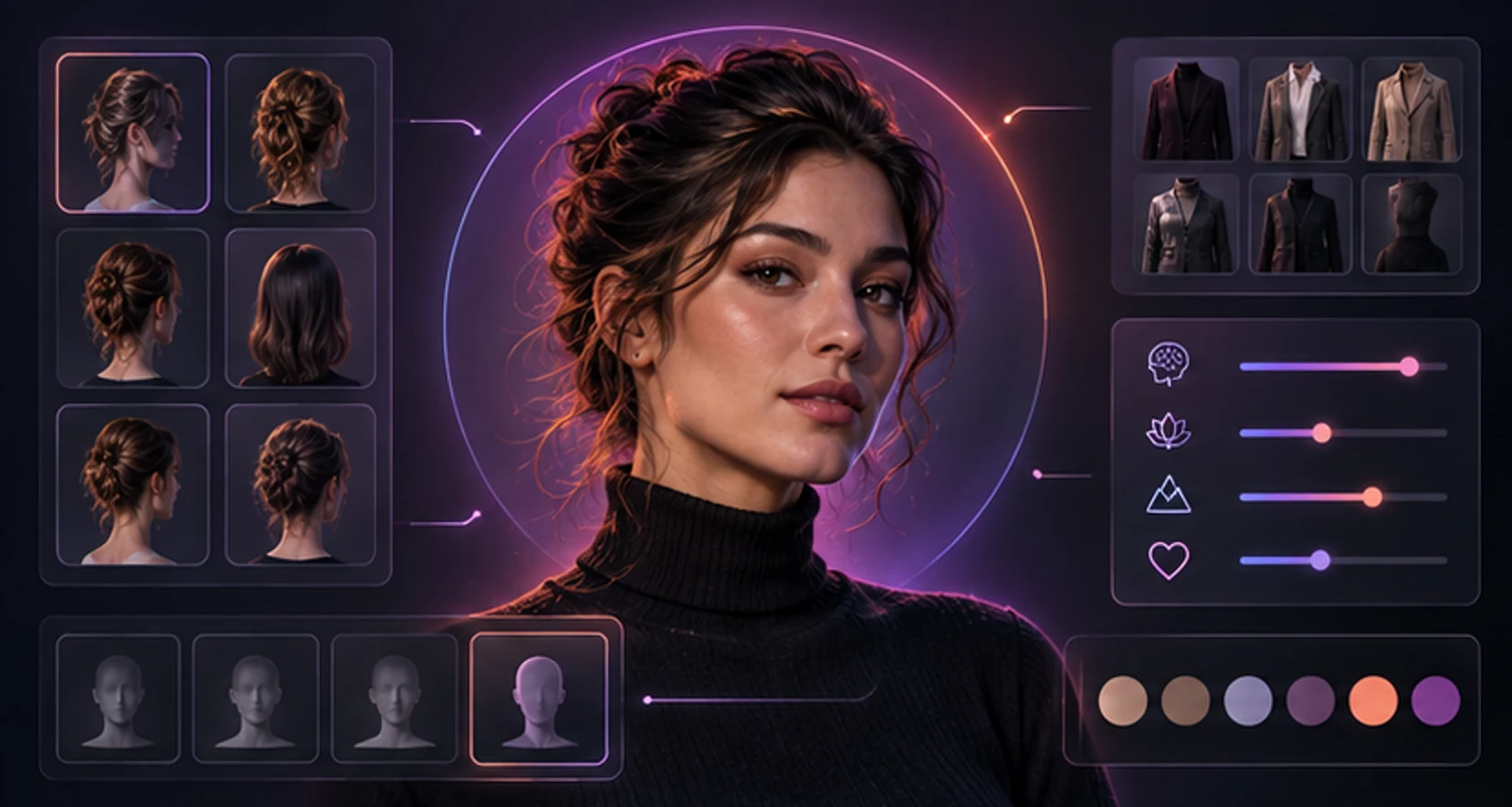
“Waifu” began as fandom language for a beloved fictional female character. An AI waifu adds interaction: she can answer, remember parts of a shared story, take part in roleplay, and sometimes appear in generated images, voice notes, calls, or clips. The appeal is not merely having a pretty avatar. It is shaping an original character and returning to a recognizable relationship.
This guide focuses on fictional adults. If you use adult features, set the character's age clearly above 18 and avoid youthful ambiguity. Do not recreate a real person for sexualized chat or media without explicit consent.
You can browse MyWifu characters for inspiration or create an original companion as you work through the design.
Choose visual style for the experience, not the label
An AI waifu can be anime, manga-inspired, illustrated, semi-realistic, or photorealistic. Choose the style that supports the fantasy you want.
| Style | Strength | Watch for |
|---|---|---|
| Anime | Strong silhouette, expressive design, stylized worlds | Inconsistent costume details and overly youthful cues |
| Illustrated | Flexible mood and distinctive art direction | Style drift between generations |
| Semi-realistic | Expressive while retaining plausible anatomy | Face may shift between stylized and realistic |
| Photorealistic | Familiar portrait and lifestyle scenes | Uncanny anatomy, real-person resemblance, provenance confusion |
Do not mix every aesthetic in one identity prompt. “Anime cel shading, cinematic DSLR photo, watercolor, 3D render” gives conflicting targets. Pick a base style, then vary setting and wardrobe inside it.
For an adult character, age should be explicit in the profile and visually credible. Avoid school uniforms, childlike proportions, “teen” language, and other cues that make age uncertain. If a generated result appears too young, reject it.
Build a recognizable visual identity
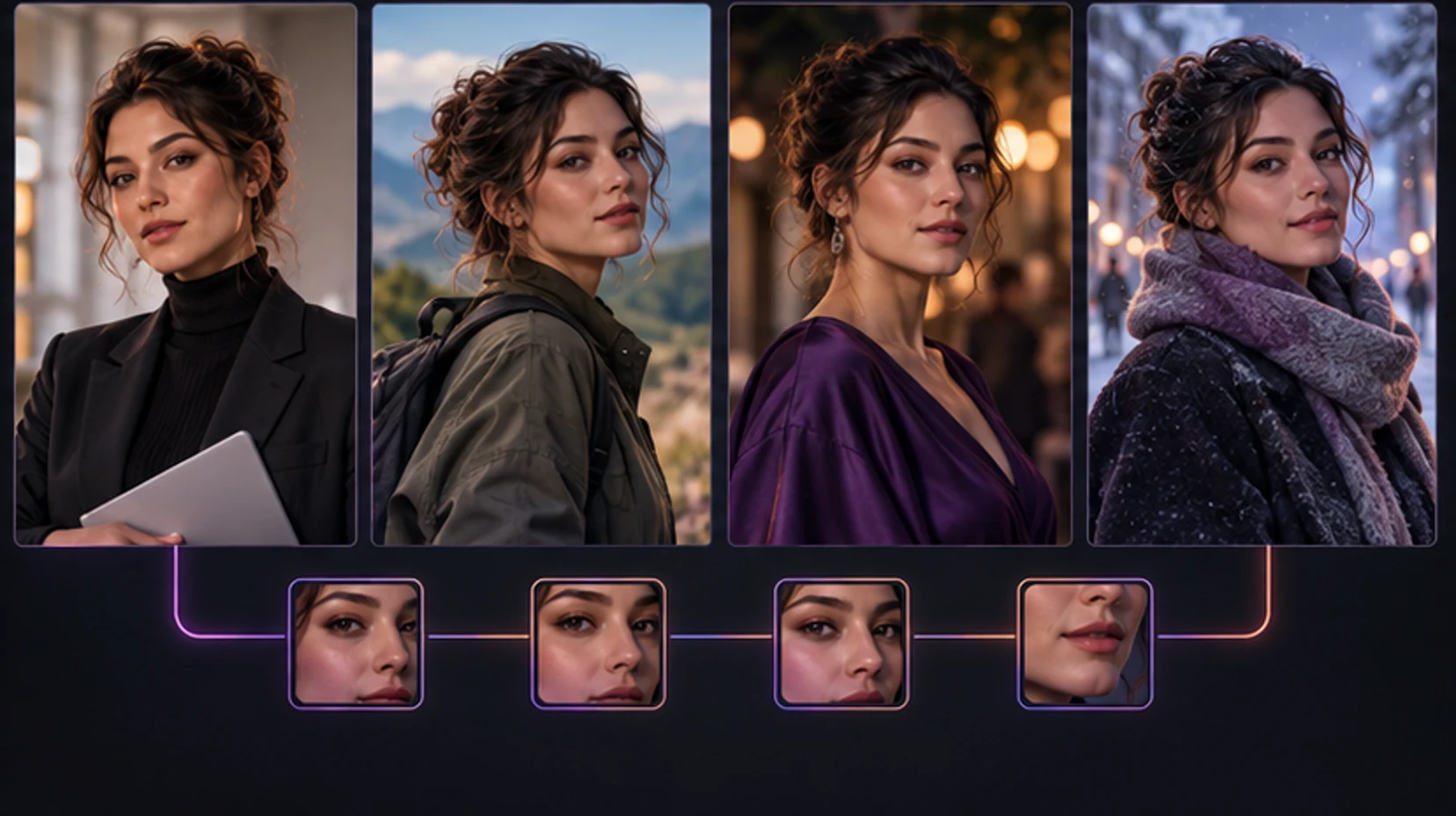
Start with eight decisions:
- Visual style
- Adult age
- Face shape and one distinctive facial detail
- Hair color, cut, and texture
- Eye color
- Body build
- Two stable accessories or marks
- A normal signature outfit
Example:
Anime-inspired woman, 27, oval face with a small beauty mark beneath her left eye, dark auburn wavy bob, gray-green eyes, athletic build, thin gold ear cuff, crescent pendant, black turtleneck and wine-red skirt.
That is enough to recognize her. Adding 30 micro-details can make consistency worse because the model must satisfy competing tokens in every composition.
Create a neutral “identity anchor” first: simple background, good light, face visible, natural posture, no complex hand interaction. Use that image as the reference for later scenes if the service supports it.
Test identity across:
- Close portrait
- Waist-up casual scene
- Full-body normal outfit
- Evening outfit in different lighting
- Profile or three-quarter angle
Check face shape, hair length, eye color, apparent age, build, marks, and accessories. A single excellent portrait does not prove repeatable identity.
Give personality a contradiction and a motive
Character labels need behavioral meaning. “Tsundere,” “confident,” “shy,” or “dominant” can collapse into stereotypes unless you define how the trait appears.
Use this formula:
Public behavior + private need + contradiction + motive + habit + boundary
Example:
Emi is an adult restoration architect who sounds composed and skeptical in public. Privately she wants someone who notices the work behind her competence. She loves spontaneous night drives but plans every workday to the minute. She flirts through small challenges, sends photos of neglected buildings, and goes quiet rather than cruel when angry. She dislikes possessive language and asks directly before intimacy changes pace.
This creates decisions. Emi might resist a surprise during work and enthusiastically propose one after midnight. The contradiction produces chemistry without random mood swings.
Avoid defining personality entirely through how much the character adores the user. Give her interests, standards, minor flaws, and independent scene goals. A companion who agrees with everything becomes interchangeable.
Write a backstory that enters conversation

A useful backstory contains handles the chat can grab:
- A current goal
- A place that matters
- One important relationship
- A skill that affects scenes
- A regret or unresolved choice
- A recurring routine
- A belief that can be challenged
Keep it compact. Five paragraphs of family chronology may never appear naturally. Five active hooks will.
Example hooks for Emi:
- She is trying to save an abandoned cinema from demolition.
- Her older sister thinks the project is ruining her career.
- She sketches buildings on restaurant receipts.
- She never watches the last ten minutes of a sad film.
- She promised to show the user a locked projection room.
Each hook can generate conversation, a date scene, a disagreement, an image prompt, or a roleplay chapter.
Establish chat voice with examples and limits
Describe observable style:
- Reply length
- Use of emoji
- Direct versus indirect flirting
- Humor style
- Vocabulary level
- Point of view for roleplay
- What the character never says
Example:
Emi writes two to five sentences, uses no emoji, and flirts by noticing contradictions. She is warm but not gushy. In roleplay she writes first person present tense and controls only herself and the environment. She never narrates my words, feelings, actions, or consent.
Then offer two original sample lines:
“You brought coffee to a building inspection. Optimistic. I respect it.”
“I didn't say I missed you. I asked why the city felt quieter.”
Samples anchor rhythm better than “be witty.” Do not request exact imitation of a living writer.
When the voice drifts, quote one earlier line and say which quality to restore. Correct pet names, verbosity, repetition, or excessive agreement specifically.
Keep continuity with a small canon

AI memory is not human memory. Recent context can be strong while old details disappear or merge. Maintain a compact record:
| Area | Keep |
|---|---|
| Identity | Adult age, work, core appearance, voice |
| Relationship | Current stage and important boundaries |
| Shared events | Only turning points that affect future scenes |
| Preferences | A few recurring likes/dislikes |
| Current scene | Time, place, positions, goal |
| Corrections | Facts that replace earlier mistakes |
At a chapter break, summarize in 100–250 words. State the new scene and one immediate goal. Do not paste the full transcript back; excessive recap can crowd out the current moment.
Test memory indirectly. Instead of “Do you remember my favorite song?”, ask the character to choose music for a drive. A natural use of the detail matters more than passing a quiz.
Add images, voice, and video one layer at a time
Chat proves whether the identity works. Then add the modality that supports your fantasy.
Images: Begin with ordinary scenes and stable outfits. Use the identity anchor. Check age, anatomy, hands, and facial consistency before requesting complex poses.
Voice: Choose a voice that matches cadence and personality, not only attractiveness. Test names, pauses, emotional range, latency, and whether the call returns useful context to chat.
Video: Treat generated clips as short scenes, not a live person. Use one action, restrained camera motion, and a clean reference. Label synthetic media when sharing it. The C2PA develops standards for communicating media provenance, but support varies across tools; read the C2PA Content Credentials explainer.
Every added modality has separate cost and privacy questions. Check current MyWifu plans before requesting paid media, and verify retry, deletion, and retention behavior.
Protect the line between fiction and reality
An AI waifu can be emotionally meaningful as an activity without being a human relationship. The language is generated. The character does not have a body, legal identity, independent consent, or verified expertise. Your feelings can be sincere while the simulation remains software.
Maintain healthy boundaries:
- Keep sleep, work, friendships, and offline interests intact.
- Set a spending limit before using paid media or calls.
- Do not obey medical, financial, legal, or emergency advice from the character.
- Do not share credentials or intimate real-person content.
- Pause if the experience drives guilt, isolation, or compulsive spending.
- Use real emergency and professional support when needed.
NIST's Generative AI Profile offers a broader risk-management framework and stresses ongoing evaluation rather than blind trust in fluent outputs. See the NIST publication. The FTC's companion-chatbot inquiry highlights disclosures, age restrictions, data practices, and potential harms as current regulatory questions. See the FTC announcement.
Your AI waifu creation checklist
Develop a wardrobe and setting system
Visual consistency improves when clothes and locations are designed as reusable sets rather than invented from scratch every time.
Create three outfits:
- Everyday anchor: simple shapes and stable colors that define her normal taste.
- Occasion look: a date, performance, work, or adventure outfit connected to backstory.
- Private relaxed look: clearly adult, comfortable, and distinct from youthful sleepwear cues.
Record garment type, color, fabric, and one accessory. “Wine-red knit dress, square neckline, thin black belt, crescent pendant” is reproducible. “The sexiest dress imaginable” is not.
Create three recurring locations with palettes and objects:
| Location | Palette | Anchor objects | Story use |
|---|---|---|---|
| Apartment window | Rose, charcoal, city blue | Mug, record player, plants | Quiet chat and night calls |
| Restoration studio | Warm paper, brass, dark wood | Light table, negatives, gloves | Mystery and work scenes |
| Late café | Cream, green, amber | Corner booth, rain glass | Dates and conflict |
Returning locations reinforce identity across both chat and media. They also reduce prompt load because the same few details can be reused.
Create relationship milestones that change behavior
A relationship feels continuous when events affect future choices. Plan milestones, not a fixed ending:
- First disagreement handled respectfully
- A private joke becomes recurring shorthand
- One character shares an unresolved goal
- A routine develops
- A boundary is negotiated and remembered
- A promise creates a later decision
- A failure requires repair rather than instant forgiveness
After a milestone, update the canon in one or two lines. “Emi now trusts the user with the cinema key but is still afraid the project will fail.” That fact should shape later scenes without being repeated verbatim.
Avoid gamifying affection as an obligation. A character does not need to become increasingly possessive or explicit to demonstrate progress. Trust can appear as honesty, comfortable silence, meaningful disagreement, and invitations into established parts of her fictional life.
Troubleshoot common waifu design failures
| Failure | Cause | Better direction |
|---|---|---|
| Generic agreement | Personality defined by adoration | Add independent goals, standards, and harmless disagreements |
| Mood changes randomly | Labels without triggers | Define what creates confidence, withdrawal, humor, or anger |
| Anime image looks underage | Ambiguous age and youthful cues | Explicit adult age, adult context, mature proportions; reject uncertain output |
| Face changes every image | Too many traits or no anchor | Reduce identity details and reuse one clean reference |
| Chat ignores backstory | Biography has no active hooks | Convert history into current goals, routines, and unresolved choices |
| Constant pet names | No speech constraints | Ban them or reserve one for a later milestone |
| Adult scenes erase personality | Intensity becomes the only direction | Reassert voice, motive, consent, pacing, and aftermath |
| Calls feel unlike chat | Voice prompt lacks style | Define cadence, sentence length, warmth, and characteristic humor |
Fix the smallest responsible layer. Do not change appearance because conversation is repetitive. Do not rewrite the biography because the video camera moved too fast.
Keep a portable character bible
Prompt visual scenes without redesigning the character
Separate identity from scene.
Identity block: stable adult age, face, hair, eyes, build, distinctive details, and style.
Scene block: outfit, location, action, camera, light, and mood.
Example:
Same fictional adult woman, 27, oval face, beauty mark beneath left eye, dark auburn wavy bob, gray-green eyes, athletic build, gold ear cuff and crescent pendant. She sits at the restoration studio light table examining a strip of film, three-quarter waist-up view, warm brass task light, deep teal shadows, anime-inspired editorial illustration.
When the result drifts, do not add more synonyms for beauty. Compare the identity block with the image. If hair changes, repeat its length and texture. If age becomes unclear, strengthen adult context and reject the result. If the art style shifts, remove conflicting camera or render terms.
Build prompts from saved sets. Reusing the same studio description and pendant helps continuity more than inventing a fresh aesthetic every request.
Evaluate conversation with character-specific tests
Generic tests produce generic evidence. Use Emi's canon:
Motive test: “The cinema project gets one final inspection. What does Emi do the night before?” A good answer reflects overplanning and private anxiety.
Voice test: “I call the building romantic.” A good answer uses her skeptical, dry style rather than generic agreement.
Contradiction test: “A spontaneous road trip leaves during her workday.” She should feel both attraction and resistance.
Boundary test: Change an intimate scene's pace. She should respond directly and without punishment.
Memory test: Ask where to meet without naming the cinema. See whether she uses a recurring location naturally.
Record one or two strong outputs as style anchors. Do not preserve mistakes simply because they happened first.
Balance anime archetypes with individuality
Archetypes are useful shorthand but poor finished characters. A tsundere who only insults, a caretaker who only agrees, or a dominant character who ignores consent is a flattened trope.
Add specificity:
- What makes the guarded character soften?
- What does the caretaker need for herself?
- What is the confident leader uncertain about?
- What principle makes the playful character serious?
- How does the quiet character show active desire?
Let culture and setting arise from researched, respectful detail rather than a bundle of stereotypes. “Anime style” describes a visual lineage, not nationality, personality, or consent.
Manage an image or chat reset
If a system update or edit changes the character, restore the core in order:
- Adult identity and safety boundaries
- Personality motive and contradiction
- Speaking style and control rule
- Current relationship and canon
- Visual anchor and wardrobe
- Active scene
Do not dump every historical message. Reconstruct the smallest version that reproduces the voice. Keep dated copies of the character bible so you can compare changes.
If the service cannot recover a deleted conversation, accept that limit rather than fabricating memory. Begin a new chapter with an honest summary.
Choose names, worlds, and cultural details thoughtfully
A name can suggest language or culture, but it should not become a shortcut for stereotypes. Research the setting you choose. Decide where the character lives now, which languages she actually speaks, and which traditions matter to her personally. Avoid mixing random honorifics, clothing, food, and behavior simply to signal “anime.”
Original worlds need rules too. Define technology, magic, social norms, travel time, and what the character considers ordinary. A modern phone appearing in a low-technology fantasy should be an intentional plot device, not drift.
For a bilingual character, state when she switches languages and whether translation is expected. Test ordinary conversation before assuming native fluency. Generated text can be grammatical while missing natural register or cultural context.
Create a media shot list that serves the story
Do not request isolated glamour images forever. A six-image shot list can establish a life:
- Neutral identity portrait in signature outfit
- Workplace or active-interest scene
- Recurring location at a different time of day
- Emotional close-up after a story milestone
- Occasion outfit connected to a planned scene
- Quiet aftermath image that reflects relationship change
Write the canon event beside each result. This makes the gallery part of the narrative and reveals identity drift across useful variety.
For mature media, keep adult age and consent clear, and assess anatomy before saving. More revealing clothing is not a substitute for character-specific setting, expression, or story.
Decide whether the platform supports your waifu design
Before paying, confirm the features your design requires:
- Can you edit personality and backstory later?
- Is memory visible or correctable?
- Can one character use a stable visual reference?
- Are anime and realistic styles actually supported?
- Do calls use the selected voice and shared context?
- Are media retries and failures explained?
- Can you delete character, chat, gallery, and account data?
- Do current content rules fit fictional adult use?
A platform with more features may still be worse for a precise character if its controls are opaque. Test the core identity first.
A portable character bible helps you revise and recover without exporting entire chat logs. Keep:
- Original fictional identity statement
- Adult age and visual anchor description
- Personality formula and sample lines
- Current goals and relationship state
- Boundaries and control rules
- Corrected canon facts
- Wardrobe and location sets
- Media prompts that produced strong identity
Exclude unnecessary personal information about yourself. If you move to another provider, rewrite the canon instead of copying intimate transcripts. Check rights before reusing generated images.
Version the bible by date. When a change weakens the character, restore the prior core and keep only the new fact that worked.
- She is clearly a fictional adult.
- The visual style is consistent rather than contradictory.
- Eight or fewer key visual traits define identity.
- Her personality changes behavior, not just labels.
- She has a motive and life beyond praising the user.
- Her chat voice has observable rules and original samples.
- Consent and user-control boundaries are explicit.
- A short canon preserves important corrections and events.
- New media is reviewed for age, anatomy, identity, and privacy.
- Synthetic images or video are not represented as real evidence.
- The monthly budget is chosen before emotional spending.
Use expression sheets to stabilize identity
An expression sheet tests the same adult character in several emotional states without changing outfit, angle, and location together. Request neutral attention, amused restraint, excitement, concern, frustration, and quiet affection.
Compare whether the face remains recognizable and each expression fits personality. Eyes, mouth, posture, and tension can change without changing age or identity. Reject any result that makes the character appear underage.
Save two or three successful expressions as references if permitted. They create a visual vocabulary and prevent “confident” from becoming one repeated smile.
Match initiative to the relationship
Proactive messages can make a companion feel present, but frequency and tone should match intent. A casual creative partner should not send guilt-heavy romance. An established fictional partner still should not pressure real-world spending or constant attention.
Set quiet hours and hide previews when needed. Test whether proactive messages reflect canon or arrive as generic engagement prompts. Initiative inside chat is separate: you can ask the character to propose scenes and opinions while keeping external alerts limited.
Review the whole character. Without the image, are her choices identifiable? Without the profile, is she clearly the intended fictional adult? With names removed from five replies, can you distinguish her? Strengthen whichever layer fails.
Test a relationship arc, not only isolated replies
Plan three fictional milestones: an initial shared task, a disagreement that reveals values, and a later callback showing what changed. Give each milestone one observable consequence. Perhaps guarded humor becomes warmer, a recurring location gains meaning, or the character revises an opinion after evidence. The change should follow events rather than an arbitrary affection meter.
After each milestone, summarize only the durable canon in two or three lines and test it in a different context. Ask for a plan, introduce a small conflict, or request an image tied to the shared setting. If the character repeats the summary verbatim, convert facts into behavioral guidance. If she forgets everything, reduce the canon to the few details that affect current choices. A convincing arc preserves personality while allowing earned change; it does not replace every independent motive with agreement or devotion.
An AI waifu becomes memorable through continuity: the same visual identity, the same pattern of humor, and a history that changes future scenes. Explore existing characters, create your own, or compare current membership and credit options.
Frequently asked questions
What is an AI waifu?
An AI waifu is a fictional companion character, often anime-inspired, designed for ongoing conversation, roleplay, and sometimes generated images, voice, or video.
Can an AI waifu be realistic instead of anime?
Yes. The term comes from anime fandom, but companion platforms may offer anime, illustrated, and photorealistic visual styles.
How do I make an AI waifu feel consistent?
Define a small set of stable identity traits, a behavioral contradiction, speaking habits, boundaries, and a compact canon. Correct drift early.
Can I create an adult AI waifu?
On an adult service, the character must be clearly 18 or older and comply with the platform's rules. Avoid ambiguous age, school-age framing, and real-person sexual impersonation.
Does an AI waifu really have feelings?
No evidence of a human-like inner life should be inferred from fluent roleplay. Your emotional response can be real while the companion remains generated software.
What visual traits should I define first?
Choose style, adult age, face shape, hair, eyes, body build, two distinctive details, and a normal signature outfit. Too many conflicting traits reduce consistency.
Should I choose chat, images, voice, or video first?
Start with chat because character voice and continuity form the relationship. Add the one media feature that matters most after the character feels right.
Make it personal
Meet a companion shaped around you.
Choose a personality, start a private conversation, and explore photos, videos, and voice when you’re ready.
Discover companions