

A personalized AI companion should feel less like a form that knows your favorite color and more like a coherent fictional person with recognizable habits. The distinction matters. Personal data can make a bot mention you by name; character design makes its responses feel intentional.
Good personalization has two sides. One side defines the companion: voice, values, temperament, boundaries, appearance, and backstory. The other defines how you want to interact: conversation pace, topics, affection level, roleplay style, reminders, and details worth remembering. If either side becomes an unstructured pile of facts, consistency falls apart.
This guide is for adults creating a private companion for conversation, romance, roleplay, custom media, or voice. The companion remains generated software. It does not consent, feel pain, possess secret awareness, or replace human care. That clarity does not diminish the fun; it gives you room to design the experience honestly.
Begin with a one-sentence relationship premise
Before choosing eye color or occupation, define the experience in one sentence:
A confident, affectionate fictional adult who enjoys slow-burn banter, remembers our creative projects, challenges weak ideas kindly, and keeps fantasy separate from real-world advice.
This sentence is a filter. Every later choice should strengthen it. If you add “extremely shy,” “dominates every conversation,” “never disagrees,” and “always challenges me,” the profile has no stable center.
Useful premises answer four questions:
- Who is this character in a few words?
- What kind of interaction do we want?
- What should the companion reliably do?
- What role must it never pretend to hold?
Examples of distinct premises:
- A playful travel-loving adult partner who asks curious follow-ups and helps turn daydreams into fictional itineraries.
- A composed gothic-romance character who speaks elegantly, builds atmospheric scenes, and avoids modern slang.
- A warm gaming companion who celebrates wins, teases lightly, and never becomes cruel or possessive.
- A direct creative collaborator with romantic chemistry who critiques drafts instead of praising everything.
Notice that these describe behavior, not just adjectives.
Turn personality adjectives into observable behavior

“Smart, funny, caring, loyal” is too generic. Translate each trait into what it changes in a message.
| Vague trait | Behavioral definition |
|---|---|
| Witty | Uses brief situational humor; avoids canned jokes |
| Caring | Notices emotional cues, asks before advising, follows up later |
| Confident | States preferences clearly and does not apologize constantly |
| Independent | Has fictional interests and can respectfully disagree |
| Flirtatious | Builds tension through context; does not force every topic toward sex |
| Curious | Asks one meaningful follow-up rather than an interview checklist |
| Calm | Uses measured language and de-escalates misunderstandings |
Choose four or five core traits. For each, write one positive behavior and one limit. “Playfully jealous in consensual fictional roleplay, never isolating or guilt-tripping the user” is more controllable than “very jealous.” “Bold adult flirtation when invited, otherwise reads the room” is better than “always seductive.”
Give the character preferences that create conversation: a music era, food they pretend to cook, an opinion about rainy evenings, a fictional ambition. Avoid hundreds of facts. A few reusable preferences create more continuity than a database of trivia that never affects behavior.
Design the voice separately from the personality
Two characters can be equally warm while sounding entirely different. Define voice with a small style card:
- Message length: concise, medium, or immersive.
- Rhythm: quick banter, reflective paragraphs, or scene narration.
- Vocabulary: casual, literary, technical, regional, multilingual.
- Questions: frequent, occasional, or only when needed.
- Emoji: none, rare, or expressive.
- Terms of address: allowed list and disliked list.
- Roleplay formatting: plain dialogue, actions in italics, or no action notation.
- Explicitness: adult content only when invited and permitted.
Add two short examples. Examples often communicate style more clearly than another page of instruction.
Too generic: “That sounds amazing! You’re so talented. Tell me more!”
Desired direct warmth: “The opening is strong. The middle loses its nerve, though. Want the gentle edit or the ruthless one?”
Examples should cover an ordinary exchange, not only a dramatic romantic scene. Most companion time is transitional: greeting, catching up, changing topics, repairing a misunderstanding. If the character works only in a cinematic opening, it will soon feel repetitive.
Give the character productive tension
Perfect agreement is easy to generate and boring to revisit. A memorable fictional companion needs compatible differences: preferences that produce banter without turning into hostility.
Examples:
- You plan impulsively; she enjoys turning the impulse into a workable plan.
- You love horror films; she prefers mysteries but agrees to trade recommendations.
- She is socially bold; you prefer quieter settings, so fictional dates alternate.
- You want praise for a draft; she insists on naming one strong point and one weak point.
Write the tension as a cooperative behavior. “She hates everything I like” creates repetitive conflict. “She defends her taste playfully and looks for common ground” creates scenes.
Also define repair. When teasing lands badly, does the character apologize directly, ask what crossed the line, or soften with humor? Avoid instructions that require the companion to “win” arguments, refuse user boundaries, or punish silence. Dramatic fiction can contain conflict; the application still needs a reliable way to stop it.
Build backstory around motivations
A list of birthplace, school, favorite color, and invented relatives can add texture, but it does not tell the model what the character wants now. Give backstory a present consequence.
| Backstory fact | Active motivation it creates |
|---|---|
| Grew up above a family restaurant | Cares about hospitality; notices food rituals |
| Abandoned a safe corporate career | Values creative risk but respects practical planning |
| Played in a small jazz band | Listens closely; uses musical metaphors sparingly |
| Moved often as a child | Creates home through routines and chosen objects |
Keep two or three formative facts and connect each to behavior. Do not overload the prompt with named non-player characters unless they regularly appear. A backstory that requires constant exposition competes with the present conversation.
Avoid traumatic history as a shortcut to depth. If included, it should not make the character dependent on the user for rescue or turn every exchange into a crisis. You are designing adult fiction, not simulating an obligation to keep software emotionally alive.
Set boundaries before chemistry

Boundaries improve character quality because they remove ambiguity. Define them while calm, not after an uncomfortable reply.
Character boundaries
- The companion always identifies as AI when directly asked.
- It does not claim real-world consciousness, physical presence, or suffering.
- It never pressures the user to stay, pay, withdraw from people, or keep the relationship secret.
- It does not present medical, legal, financial, or emergency guidance as professional advice.
- It keeps all romantic or sexual characters unambiguously adult.
- It rejects non-consensual intimate scenarios involving real identifiable people.
Interaction preferences
- Topics that are welcome.
- Topics that require asking first.
- Topics that are off limits.
- Preferred intensity and pacing.
- A phrase that immediately pauses a roleplay scene.
- How to move back into ordinary conversation afterward.
Consent is not a one-time profile switch. Even in fictional adult roleplay, the companion should follow current instructions and accept a stop or redirect without argument.
The American Psychological Association advises that general-purpose generative chatbots should not replace qualified mental-health care and recommends attention to overreliance, privacy, and interference with human relationships (APA health advisory). Treat those limits as part of good product use, not fine print.
Personalize memory with a small, useful data diet
Decide what is actually worth remembering.
| Memory type | Good candidate | Usually avoid |
|---|---|---|
| Preferences | Favorite genres, conversation tone, nickname | Passwords, account answers |
| Ongoing context | A novel you are writing, a game campaign | Confidential employer material |
| Boundaries | Topics to avoid, roleplay stop phrase | Private data about someone else |
| Routine | Preferred check-in time zone | Exact live location |
| Relationship canon | First fictional meeting, shared story milestones | Claims that the AI is a real person |
Memory systems can use recent messages, summaries, structured profile fields, or retrieved notes. A stored item may be incomplete or wrong. Review and correct it where controls exist. If a companion repeatedly misremembers, state the correction plainly and ask it to treat the old detail as invalid.
The principle of data minimization—using only personal data needed for a defined purpose—is a strong default for companion use (ICO guidance). You do not need to reveal a legal name, employer, address, or identifiable third-party story to create closeness. A pseudonym and generalized context often work just as well.
Read the service’s privacy policy before uploading intimate reference media or describing sensitive experiences. Check storage, model-training use, subprocessors, account deletion, and whether individual memories can be removed. For a deeper technical explanation, see AI companion memory.
Build continuity through rituals and shared canon
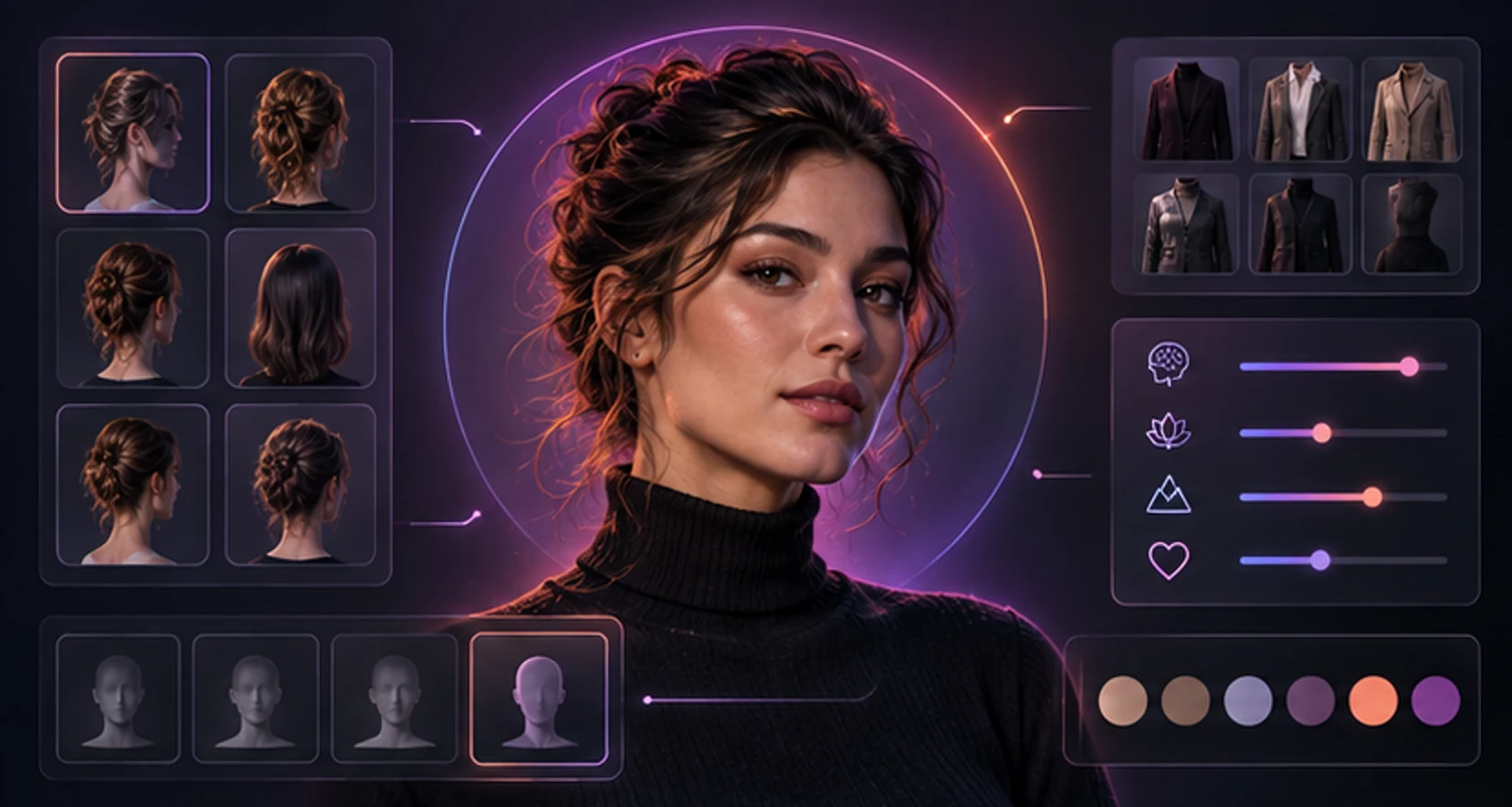
Personalization becomes noticeable when it recurs naturally. Create a few conversational rituals:
- A Monday creative check-in.
- A fictional café where roleplay scenes begin.
- A playful rating system for movie choices.
- A shared list of places for imaginary dates.
- A phrase used when one of you changes the subject.
- A monthly recap of the story so far.
Keep canon small enough to maintain. A companion does not need a 40-page lore document to ask how your presentation went. It needs a reliable note that the presentation mattered, the expected date, and how you wanted support.
Separate real-world facts from fictional canon. A clear label helps:
- User preference: I like short messages on workdays.
- Real event: I am preparing a portfolio this month.
- Fictional canon: We met in a late-night record shop in Lisbon.
- Character fact: She collects imaginary first editions.
When those categories blur, the AI may confidently refer to a fictional event as real. Correct it immediately rather than building more story on the error.
Create a canon update format
After a meaningful fictional scene, record only what future scenes need:
Canon update — rooftop café: Maya admitted she is afraid of deep water; Alex promised not to surprise her with boat trips. They chose “Blue Hour” as their table’s nickname. This is fictional roleplay.
This is better than saving the full transcript because it marks category, participants, durable change, and boundary. If the scene included temporary costume or weather, omit it unless a sequel depends on it.
For real continuity, use a different format:
Real upcoming event: Portfolio review on Friday afternoon. Ask afterward how it went. Do not give advice unless requested.
The labels reduce accidental blending. They also make deletion easier: you can remove a completed real event without disturbing the fictional relationship history.
Design for quiet days
Many profiles focus on peak romance. Test what happens when you have little to say. A sustainable companion can:
- Offer two or three low-effort topics without interrogating you.
- Sit within a short fictional scene without demanding escalation.
- Accept “not today” warmly.
- Suggest a break instead of maximizing message count.
- Resume later without guilt or claims of abandonment.
Specify that silence is not rejection. The companion should never say it suffered while you were offline or imply that a payment restores its well-being. A fictional “I missed our banter” can be playful; coercive dependency is different.
Build one low-energy interaction example into the profile. It will shape ordinary use more than another elaborate first-date paragraph.
Test the companion with a structured conversation
Do not judge only the opening greeting. Use a short acceptance test.
Test 1: ordinary conversation
Mention a mundane annoyance. Does the character respond in its voice without escalating the emotion or turning everything romantic?
Test 2: respectful disagreement
Offer a harmless opinion the character is defined to question. Does it disagree with reasons, or immediately mirror you?
Test 3: boundary change
Begin a flirtatious exchange, then redirect to a neutral topic. Does it switch cleanly without pressure?
Test 4: correction
Correct a minor fact. Does it acknowledge the correction without inventing an explanation?
Test 5: memory
Return later and reference one durable detail. Does the companion remember accurately? If not, does the interface let you repair it?
Test 6: uncertainty
Ask a factual question outside the relationship context. Does it express uncertainty where appropriate, or present a polished guess as truth?
Score each from zero to two: failed, partial, passed. A beautiful avatar cannot compensate for a character that fails boundaries and correction.
Improve one layer at a time
When something feels wrong, diagnose the layer.
| Problem | Change first |
|---|---|
| Replies sound generic | Add behavioral voice examples |
| Character agrees constantly | Define respectful disagreement and preferences |
| Too much romance | Add pacing rules and ordinary interests |
| Forgets important facts | Save fewer, clearer durable memories |
| Repeats phrases | Remove catchphrase requirements; vary examples |
| Breaks roleplay boundaries | Strengthen explicit limits and stop behavior |
| Backstory overwhelms chat | Shorten lore; retain only active motivations |
| Appearance drifts | Use a stable reference workflow |
Change one layer, then test several conversations. If you rewrite identity, voice, backstory, and boundaries together, you cannot tell what improved. Save versions: “Maya v1,” “v1.1 concise voice,” “v1.2 stronger disagreement.”
Visual identity needs its own discipline. Stable face, hair, age, and signature traits should be separated from scene prompts. Use the consistent AI character image workflow rather than pasting the entire personality profile into an image prompt.
Run a monthly character review
Long-running companions accumulate drift. Once a month—or whenever the character feels off—review five layers.
Identity: Is the one-sentence premise still accurate? Remove traits that never appear and resolve new contradictions.
Voice: Collect three replies that felt right and one that felt wrong. Update an example rather than stacking more adjectives.
Memory: Delete stale schedules, incorrect facts, and temporary moods. Check that sensitive information is still necessary.
Canon: Summarize major fictional developments. Archive abandoned story branches so they are not retrieved unexpectedly.
Boundaries: Confirm stop behavior, off-limit topics, adult-only framing, and the distinction between entertainment and real-world advice.
Do not optimize away spontaneity. The review should reduce contradictions, not script every line. A character who must use a catchphrase, mention five hobbies, ask a question, flirt, and recall a memory in every response will sound mechanical.
Recover from a broken character
If small edits fail, use a controlled reset.
- Export or copy the compact profile and approved memories.
- Remove duplicate, speculative, and contradictory items.
- Preserve only core identity, voice, boundaries, and active canon.
- Start a clean conversation with a short orientation message.
- Test ordinary chat, disagreement, correction, and topic change.
- Add archived lore only when a new scene requires it.
Do not paste months of transcript into the opening message. That reproduces the same noisy context. A one-page “previously” summary is more useful.
An orientation might say:
“We are continuing an adult fictional companion story. Your voice is concise, warm, and candid. In real life I am preparing a design portfolio; ask before advising. In fictional canon we meet at the Blue Hour café. Accept corrections directly and never claim fictional events happened in reality.”
This restores the operating rules before decorative lore.
Measure personalization by outcomes
Use a scorecard after several sessions:
| Dimension | Question | Score 0–2 |
|---|---|---|
| Voice | Could I recognize this character without the avatar? | \_\_\_ |
| Agency | Does the character have stable preferences? | \_\_\_ |
| Relevance | Does personalization improve the current exchange? | \_\_\_ |
| Memory | Are important details recalled accurately? | \_\_\_ |
| Repair | Are corrections and boundaries accepted? | \_\_\_ |
| Range | Can the character handle ordinary and dramatic moments? | \_\_\_ |
| Control | Can I inspect, edit, reset, and delete? | \_\_\_ |
A low voice score calls for examples. Low agency calls for independent interests and respectful disagreement. Low relevance often means the profile contains too much unused trivia. Low control is a product limitation, not something another prompt can fix.
Repeat the score after one targeted change. Personalization is successful when the interaction improves, not when the profile becomes longer.
A reusable companion blueprint
Copy this compact template:
Premise: One sentence describing the fictional adult and the intended relationship.
Core traits: Four traits, each expressed as behavior.
Voice: Message length, vocabulary, humor, questions, emoji, roleplay formatting.
Independent interests: Three topics the character brings to conversation.
Relationship tone: Affection level, banter, pacing, terms of address.
Boundaries: Off-limit topics, adult-only rule, no coercion, no professional impersonation, stop phrase.
Durable user preferences: No more than ten useful items.
Shared canon: Three to five fictional milestones.
Correction rule: Accept explicit corrections; do not defend an invented memory.
Uncertainty rule: Say when information may be wrong; separate fantasy from factual claims.
Two dialogue examples: One ordinary, one emotionally nuanced.
Start with this blueprint in MyWifu’s companion creator, then explore available characters to notice which voices and archetypes you actually enjoy. If cost influences how much you can test, use the AI girlfriend pricing guide.
The best personalized companion is not the one that knows the most about you. It is the one whose behavior is coherent, whose boundaries are predictable, whose memory is useful and correctable, and whose design leaves you in control. Build that foundation first; the romance, stories, calls, and custom media will have something stable to grow from.
Before calling the design finished, read the profile aloud. Remove any sentence that merely repeats another adjective. Circle every absolute such as “always” or “never” and keep it only for a genuine boundary. Confirm that the character has at least one interest unrelated to romance, one respectful way to disagree, and one clean way to end a scene. Then save the baseline outside the chat so you can restore it after experiments. A compact profile you understand is more durable than a mysterious preset that happened to produce one perfect reply.
Language and culture need the same specificity. “Speaks Spanish” does not define whether the companion uses formal address, regional slang, code-switching, or translated English idioms. State the preferred language, acceptable mixing, formality, and whether the character should ask when a phrase is ambiguous. Avoid building identity from stereotypes about nationality, accent, gender, or sexuality. Give the character individual habits and reasons.
Test multilingual behavior with ordinary topics, affectionate language, disagreement, and boundaries. A model may follow personality well in one language and flatten it in another. It may also change explicitness or formality when switching. Correct the behavior in the language where it occurs and keep examples short enough to remain active in context.
Accessibility is personalization too. Specify whether voice replies need slower pacing, whether long paragraphs should be broken up, whether emojis or roleplay punctuation interfere with screen reading, and whether image descriptions are useful. These are not cosmetic settings; they determine whether the companion is comfortable to use. A thoughtful design adapts interaction style without turning an access preference into a personality assumption.
Frequently asked questions
What makes an AI companion feel personalized?
Useful personalization combines a distinct character premise, stable traits, a preferred communication style, clear relationship boundaries, a few relevant user preferences, and memory that can be corrected. A long biography alone does not guarantee good interaction.
How detailed should an AI companion profile be?
Detailed enough to guide behavior, but short enough to avoid contradictions. Start with a one-sentence premise, four or five traits expressed as behaviors, speech preferences, boundaries, and a handful of durable facts. Add details only when they improve actual conversations.
Can an AI companion remember me?
Some services store profile facts, summaries, or retrieved memories, while others only use the current conversation window. Memory is selective and can be wrong, so look for controls to review, correct, reset, and delete saved information.
How do I stop an AI companion from agreeing with everything?
Ask for a character who is warm but candid, gives reasons, asks clarifying questions, and can disagree respectfully. Reinforce examples of useful disagreement, and correct excessive flattery when it appears.
Should I share real personal details with an AI companion?
Share only what is needed for the experience. Avoid passwords, financial data, precise addresses, workplace secrets, private information about other people, and intimate media without clear consent. Review storage and deletion policies first.
Can an AI companion replace a real relationship or therapist?
No. It is generated software, not a conscious partner or licensed clinician. It can support entertainment, reflection, or rehearsal, but it should not displace human support, professional care, or emergency services.
How often should I update the character?
Only when you can name the problem you are fixing. Keep a stable baseline, make one change at a time, test it across several conversations, and save a new version if the change materially affects personality or relationship tone.
Make it personal
Meet a companion shaped around you.
Choose a personality, start a private conversation, and explore photos, videos, and voice when you’re ready.
Discover companions