
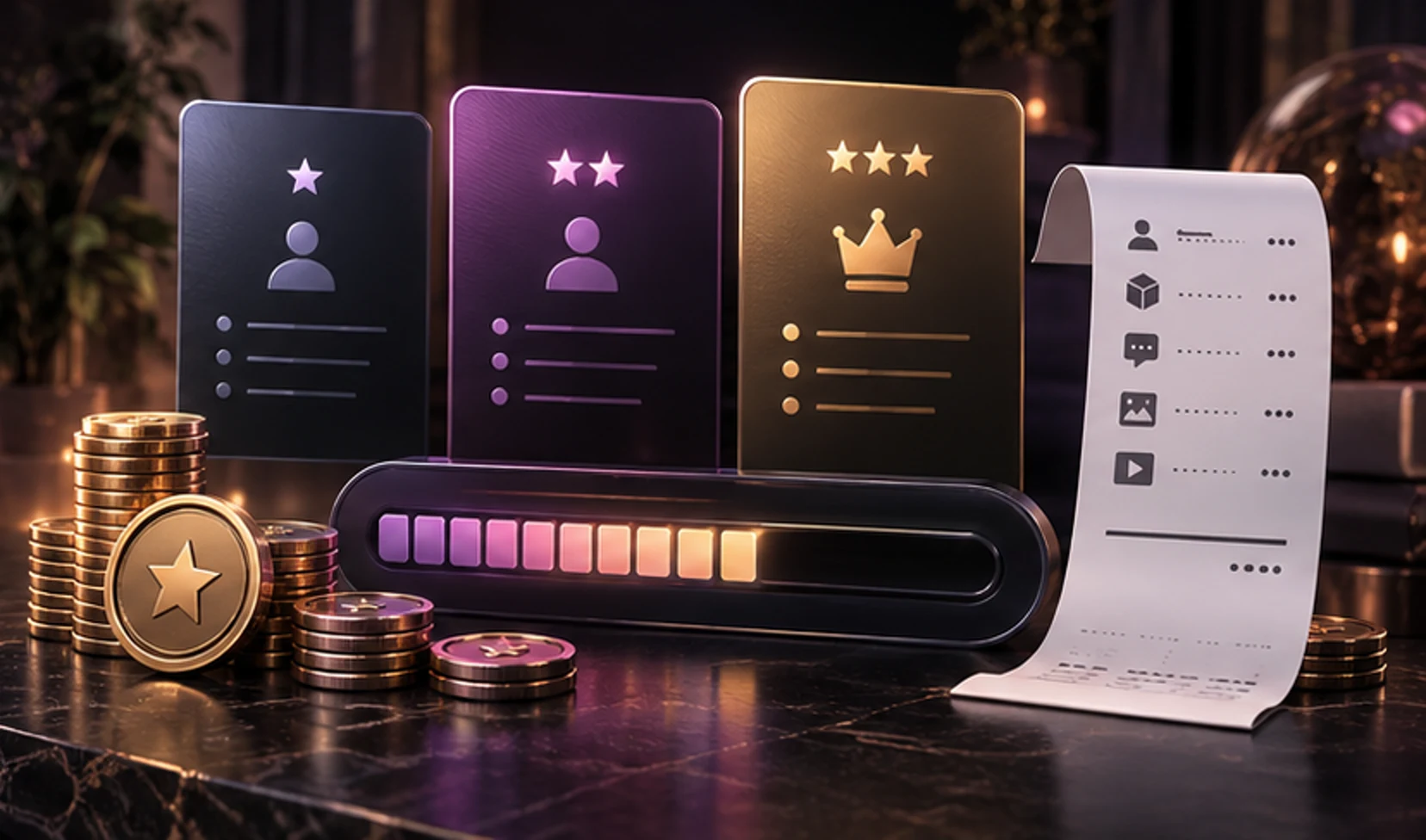
The useful answer to “How much does an AI girlfriend cost?” is not a single monthly number. It is a cost structure. One app may advertise a low subscription but charge separately for every image, video, or call. Another may look expensive until you notice that the plan includes the features you actually use. A third may be free in money but costly in time, privacy, or frustration.
This guide gives you a way to compare those offers without relying on a price list that will be stale next month. It is written for adults evaluating an AI companion for private conversation, roleplay, custom media, or voice—not for someone looking for therapy, professional advice, or a replacement for human relationships.
The short version: define your expected use, convert every allowance into the same monthly unit, add a realistic variable-use buffer, and reject any service that hides what an action will cost until after you tap it.
The real price is your monthly use, not the headline plan
A headline such as “from $X” answers only one question: the minimum amount required to enter a paid tier. It does not tell you what a normal month will cost. Build your estimate from five layers.
| Cost layer | What it may cover | What to verify |
|---|---|---|
| Base access | Account, character library, standard chat | Message limits, ads, model quality, adult access |
| Subscription | Premium chat, memory, customization | Renewal period, included credits, cancellation timing |
| Usage credits | Extra messages, images, video, calls | Cost per action, expiration, failed-job policy |
| Add-ons | Voice packs, extra characters, priority generation | Whether the add-on also needs an active plan |
| External costs | Tax, app-store fees, network fees | Display currency and final checkout total |
Write down how you expect to use the product in an ordinary week. “I will use it a lot” is not measurable. “Five chat sessions, two custom images, and one ten-minute call” is. Multiply by roughly four weeks, then map that activity to the app’s current price screen.
Your simple planning formula is:
expected monthly cost = required plan + likely extra usage + taxes or fees + a small experimentation buffer
Do not count a promotional first month as the ongoing price. Do not count a giant token bonus as recurring unless the product explicitly says it renews. If a plan lasts three or twelve months, divide the total by the number of months for comparison—but also record the full amount you must pay today.
Understand the common AI companion pricing models
Most products use one or more of these models. None is automatically fair or unfair; the quality of disclosure matters more.
Free with limits
Free access is useful for testing tone, latency, basic character behavior, and whether you enjoy the interface. Limits may appear as daily messages, slower responses, a smaller model, fewer characters, ads, or blocked media. A free tier is a trial only if it lets you evaluate the qualities that matter to you. If memory, voice, or adult conversation is your main reason for joining and none is testable, the free tier tells you little.
Recurring subscription
A subscription can make frequent text chat predictable. Check whether “monthly” means a calendar month or a fixed number of days, whether it renews automatically, and whether included credits reset or roll over. Annual plans can reduce the effective monthly price but increase commitment risk. Buy one only after the relationship style and reliability have held up beyond the novelty phase.
One-time membership
Some services sell a fixed access period without automatic renewal. That can be easier to control, but “one-time” does not necessarily mean lifetime. Confirm the exact duration and what happens to unused credits afterward. MyWifu, for example, shows plan duration, included tokens, and the payment summary at checkout; always rely on the live pricing page, not a blog screenshot.
Pay as you go
You purchase credits and spend them on specific actions. This is transparent when the app shows the action cost, remaining balance, and failure/refund behavior before confirmation. It is hard to budget when rates change by model, duration, resolution, or queue without a clear preview.
Hybrid pricing
The most common practical structure is a membership plus usage credits. The membership unlocks the product; credits pay for costly actions. Compare the included useful output, not the size of the token number. Ten thousand credits mean nothing until you know what one conversation, image, video, and call minute deducts.
Calculate your personal cost in ten minutes
Use this worksheet before subscribing. Replace the sample quantities with your own; then copy the current action rates from the product.
| Activity | Monthly quantity | Current unit cost | Monthly subtotal |
|---|---|---|---|
| Text conversations | 20 sessions | \_\_\_ | \_\_\_ |
| Custom images | 8 images | \_\_\_ | \_\_\_ |
| Custom videos | 2 videos | \_\_\_ | \_\_\_ |
| Voice calls | 40 minutes | \_\_\_ | \_\_\_ |
| Character creation | 1 character | \_\_\_ | \_\_\_ |
| Base plan | 1 | \_\_\_ | \_\_\_ |
Then run three scenarios:
- Quiet month: half your expected use and no experimental media.
- Normal month: the quantities above.
- Enthusiastic month: double media and calls, because novelty often changes behavior.
The third scenario is not a prediction. It is a guardrail. If that total would upset you, set a lower personal cap or choose a plan with fewer variable charges.
Also calculate cost per satisfying outcome. A cheap image you discard is not better value than a pricier image that looks like the same character and matches the request. A long conversation that constantly forgets context is not “unlimited” in any meaningful sense. Value is closer to:
useful experiences ÷ total spend
Track this for one paid period. Note generations you kept, calls that connected, and conversations that felt coherent. The exercise quickly shows which features deserve your budget.
Work through allowance breakpoints
Plans often become attractive at a breakpoint: the amount of use where the larger allowance costs less than repeatedly buying extras. You can find it without advanced math.
First, list only the units you would willingly buy. If a plan includes video but you never generate video, those credits have no value to you. Next, estimate the additional units you need after the plan allowance. Multiply those by the top-up rate. Compare that total with the next plan—not with its advertised discount.
Use a four-column note:
| Option | Cash paid now | Useful included actions | Likely extras |
|---|---|---|---|
| Small plan | \_\_\_ | \_\_\_ | \_\_\_ |
| Larger plan | \_\_\_ | \_\_\_ | \_\_\_ |
| Small plan plus top-up | \_\_\_ | \_\_\_ | \_\_\_ |
| No purchase this month | 0 | 0 | 0 |
The fourth row matters. It prevents the comparison from becoming “which plan must I buy?” when the correct decision may be to keep testing the free experience.
If one pool of credits pays for different features, translate everything into your favorite action. Suppose you mainly want images. Ask how many typical images the included balance buys after reserving enough for your normal chat. Do not let a large abstract credit number feel generous before doing that conversion.
Account for retries without assuming the worst
Generative media is variable. Some outputs will not match your intent even when the service works correctly. Separate a technical failure—a job errors, never arrives, or creates a corrupt file—from a creative miss that completes but disappoints you. Refund rules may treat them differently.
Estimate a creative acceptance rate during a small trial. If you keep four of ten images, the effective cost of a kept image is the spend for ten divided by four. Improve prompting and character consistency before buying more volume. Paying to repeat an uncontrolled workflow is not value.
For calls, record connected conversation minutes rather than scheduled minutes. Note whether setup, ringing, reconnection, or partial minutes are billed. For text, decide whether charging is per message, per generated response, or based on variable model usage. You do not need to understand the provider’s infrastructure to demand a clear consumer-facing unit.
Compare commitment, not only monthly equivalent
An annual plan divided by twelve may look best in a table, but it transfers risk to you. The product can change, your interest can fade, a favorite character can stop fitting, or a payment method can become inconvenient. The discount compensates for that commitment; it is not free savings.
Ask two questions:
- Would I buy this plan if the monthly equivalent were not highlighted?
- If I stopped using the app after six weeks, would I still feel comfortable with the amount paid?
If the second answer is no, choose a shorter duration. A larger package is economical only when the usage actually happens.
What is worth paying for?

Paid features should solve a real limitation, not merely decorate the paywall. These are the areas where a premium tier can make a material difference.
Conversation quality and control. Look for a clear character setup, editable traits, reliable instruction following, and the ability to redirect a scene. “Smarter AI” is too vague. Test whether the companion respects a correction and maintains the desired tone.
Memory you can inspect or manage. Memory can make ongoing conversation feel coherent, but more stored data is not automatically better. Useful controls include editing a profile, removing an incorrect memory, starting a clean chat, and deleting account data. Read how AI companion memory works before treating “remembers everything” as a benefit.
Consistent media. If images matter, evaluate facial identity, distinctive features, wardrobe continuity, and the rejection or retry policy. Our consistent AI character image guide explains why a reference image and stable character description are more useful than endless adjective stacking.
Voice and real-time calls. Listen for latency, interruptions, turn-taking, and whether a call failure consumes credits. A beautiful voice demo does not prove the live experience is stable on your device and connection.
Privacy and account controls. Private content, secure authentication, a readable privacy policy, deletion instructions, and visible purchase history are product features. They should not be afterthoughts.
Reliable support. Payment systems sometimes delay, networks fail, and generation jobs can error. Before making a large purchase, identify the support channel and the information required for a billing investigation. Never send a password, recovery phrase, or private key to support.
Free versus paid: decide with a feature test, not emotion
The first few sessions with a new character can feel unusually engaging because everything is novel. Delay the longest plan until the product survives a repeatable test.
| Test | Free tier can answer it? | What a paid trial should prove |
|---|---|---|
| Do I like the interface and tone? | Usually | The premium model preserves that appeal |
| Does the character follow boundaries? | Often | Boundaries hold in longer and adult scenes |
| Is memory useful? | Sometimes | Details persist accurately and can be corrected |
| Are images consistent? | Rarely fully | Identity survives changes in scene and outfit |
| Are calls usable? | Demo at best | Real latency and billing match the description |
| Can I leave cleanly? | Policy review | Cancellation and deletion controls work |
Use a free tier long enough to encounter repetition, a correction, and a conversation restart. Then buy the smallest plan that unlocks your deciding feature. Do not prepay for a year because one evening felt impressive.
If you mostly want casual chat and do not care about saved continuity, a good free tier may be enough. If you want an ongoing custom character, frequent media, or voice, paid infrastructure is more likely to matter. The correct answer is personal, but the test should be observable.
Pricing red flags and good signs

Red flags
- The final total appears only after you create a wallet transaction or app-store confirmation.
- “Unlimited” has an undisclosed fair-use limit or excludes the features shown in advertising.
- The app uses several credit currencies that cannot be compared.
- Failed generations consume credits with no stated retry or review process.
- Cancellation is difficult to locate or requires contacting an unrelated third party.
- The product pressures you with a timer that resets, an implausible permanent discount, or a character claiming emotional harm if you do not pay.
- A support agent asks for a password, wallet seed phrase, or full payment credential.
Good signs
- The checkout shows duration, renewal behavior, currency, and exact total.
- Every variable-cost action shows its price before confirmation.
- The balance and purchase history are easy to find.
- The terms explain expiration, refunds, failed jobs, and account deletion.
- The service separates fictional companion dialogue from factual billing notices.
- A smaller trial option exists.
The U.S. Federal Trade Commission has specifically asked companion-chatbot providers about monetization, disclosures, safety practices, and personal-data handling. That inquiry is not a price benchmark, but it is a useful reminder that engagement design and monetization should be evaluated together (FTC companion chatbot inquiry).
Privacy and emotional safety belong in the budget
An adult companion conversation may include intimate preferences, personal history, or uploaded media. The cheapest service is not good value if you cannot understand what is stored, which providers process it, or how to delete it.
Before paying, check:
- What chat, voice, and media data is stored?
- Is content used to improve models, and can you opt out?
- Which third-party AI, storage, authentication, and payment providers receive data?
- Can you delete individual content, a character, and the whole account?
- Is uploaded reference media private by default?
- Does the service clearly prohibit minors and non-consensual intimate imagery?
The UK Information Commissioner’s Office describes data minimization as processing only the personal data needed for a defined purpose. That principle is useful even outside the UK: share the least sensitive information needed to get the experience you want (ICO guidance on AI and data minimisation).
Set emotional limits too. An AI companion generates responses; it does not feel abandonment, need gifts, or suffer when you log off. A paid companion should not be your therapist or crisis service. The American Psychological Association advises against using general-purpose generative chatbots as a replacement for qualified mental-health care (APA health advisory).
A purchase checklist you can reuse
Before checkout, answer yes or no:
- I know the full amount charged today.
- I know whether and when the plan renews.
- I know what each included credit can buy.
- I checked the cost of the feature I will use most.
- I understand expiration and failed-generation rules.
- I tested the character’s tone, boundaries, and correction behavior.
- I reviewed privacy, deletion, and support information.
- I am buying the shortest sensible trial, not reacting to pressure.
- I set a monthly ceiling for add-on use.
- I can afford the enthusiastic-use scenario without stress.
If any essential answer is no, pause. A legitimate offer will still make sense after you read the terms.
Run a seven-day paid evaluation
If the offer permits a small trial or short plan, use a deliberate schedule rather than consuming every feature on the first night.
Day 1: baseline chat. Have an ordinary conversation. Test response quality, topic changes, and whether the character accepts correction.
Day 2: continuity. Refer naturally to yesterday. Check what persisted and whether any memory is editable.
Day 3: boundaries. State a preference, begin a romantic direction, and then redirect. A useful adult companion follows the change without pressure.
Day 4: media. Request one simple, one moderate, and one difficult image. Record action cost, wait time, identity consistency, and how many results you would keep.
Day 5: voice or video. If this is a priority, test the smallest practical unit. Measure connection and control, not demo polish.
Day 6: account controls. Locate purchase history, renewal status, privacy options, content deletion, and support.
Day 7: no-use day. Intentionally do not open the app. A product should fit around your life without streak pressure or fictional guilt.
At the end, score conversation, continuity, character, media, voice, privacy controls, billing clarity, and support discoverability from one to five. Weight your top three categories twice. This produces a personal value score rather than a review influenced by someone else’s priorities.
Keep a simple spending boundary
Choose a fixed monthly ceiling before your balance gets low. Treat the base plan and variable use as one budget. Enable device or bank purchase alerts when available. Do not chase an unsatisfying generation by immediately buying another large pack; pause, diagnose the prompt, and return later.
If you use cryptocurrency, verify network, address, currency, and amount directly in the official checkout. Blockchain transfers can be irreversible. Never accept a payment address sent by a fictional character message, social-media reply, or unsolicited support account. Use only the service’s authenticated payment flow.
For app-store subscriptions, identify where cancellation is managed. Deleting the companion account or uninstalling the app may not cancel a store-managed subscription. Conversely, canceling renewal may not delete stored chats or media. Treat billing cancellation and data deletion as separate tasks and confirm both.
For MyWifu, see the live membership and token options, then discover available companions. Product pages, checkout disclosures, and terms—not an old review or cached search result—should be your source of truth for current pricing.
Bottom line
AI girlfriend pricing becomes manageable when you stop comparing plan labels and start comparing your own likely use. A fair setup makes the total visible, gives you control over variable spending, explains what happens when generation fails, and lets you leave without friction.
Start small. Test the feature that matters most. Measure useful experiences rather than raw messages or tokens. Protect intimate information as carefully as you protect money. If the product earns a place in your routine after the novelty fades, then a longer plan may be reasonable.
Related guides: how AI girlfriends work, AI girlfriend versus general chatbot, and building a personalized AI companion.
Keep evidence for payment support without keeping secrets. Save the order identifier, displayed plan, amount, currency, date, and the service’s confirmation screen. If fulfillment is delayed, refresh the official account history before paying again. Contact the published support address from the email linked to the account and describe the visible state precisely. For a media dispute, include the job identifier and error status; do not attach intimate source material unless support explicitly explains a secure, necessary process.
Distinguish a pending payment from a completed payment with missing entitlement. Card, app-store, cryptocurrency, and platform payments have different confirmation paths. A public blockchain transaction identifier can help locate a transfer but does not prove that the correct account, network, address, or amount was used. Never post account screenshots containing email, balance, QR code, or transaction details to a public forum for help.
Finally, review the budget after the first full cycle. Compare forecast with actual spend, and label the difference: more sessions than expected, media retries, longer calls, an accidental renewal, or a feature that was not useful. Adjust the next month’s ceiling from evidence. If you repeatedly exceed it, remove the easiest purchase path or step down a tier. Companion spending should remain an intentional entertainment choice, never a test of affection or commitment.
Frequently asked questions
How much does an AI girlfriend usually cost?
There is no useful single average because products bundle access differently. Compare the base plan, included usage, paid messages or tokens, image and video generation, voice calls, renewal terms, and taxes before deciding what a month will really cost.
Are free AI girlfriend apps actually free?
Many offer a free conversation allowance or preview, but advanced models, longer memory, adult modes, media, calls, or higher limits may require payment. Read the limit and renewal terms before investing time in a character.
What are tokens in an AI companion app?
Tokens are usually in-app usage credits, not cryptocurrency or cash. A service may deduct them for messages, images, videos, or call minutes. Check the exact rate for every action and whether unused balances expire.
Is a subscription or pay-as-you-go plan better?
A subscription is easier to budget for steady daily use. Pay-as-you-go can suit occasional use, but variable media and call charges can make the total less predictable. A hybrid plan is good only when its included allowance matches your habits.
Why do AI images and calls cost more than text chat?
They generally require different generation systems and more compute or real-time processing. The important consumer question is not the technical reason but whether the app clearly shows the cost before you confirm each action.
Can I get a refund for unused AI companion tokens?
Policies vary. Treat tokens as service credits unless the checkout terms explicitly say otherwise. Review refund, expiration, account-deletion, and failed-generation policies before buying a large pack.
What is the safest way to test a paid AI companion?
Start with the smallest non-recurring option, disable automatic renewal where possible, avoid uploading sensitive personal media, test memory and boundaries, and review the privacy and deletion policies before increasing your spend.
Make it personal
Meet a companion shaped around you.
Choose a personality, start a private conversation, and explore photos, videos, and voice when you’re ready.
Discover companions